Private examination
Referral : not required
Result description : up to 10 working days
Examination date : available dates
Discount : 5% when paying online or at the e-kiosk (Orkana 7)
Book your appointment with a 5% discount
National Health Fund (NFZ) examination
Referral: required
Result description: up to 15 working days
Examination date: subject to availability
Check the NFZ dates
Why is it worth doing with us?
The examination is
up to 2x shorter
up to 2x shorter
3D image – better diagnostics
Less claustrophobia – more comfort
A safe test also for overweight people
Description of the magnetic resonance imaging of the shoulder joint without contrast, Lublin
Magnetic resonance imaging of the shoulder joint is a modern, safe imaging test that allows for a detailed assessment of:
- bones,
- cartilage,
- ligaments,
- tendons,
- muscles,
- joint capsule.
Thanks to high-quality shoulder MRI imaging, it can detect conditions such as rotator cuff injuries, ligament tears, degenerative changes, inflammation, and post-traumatic complications.
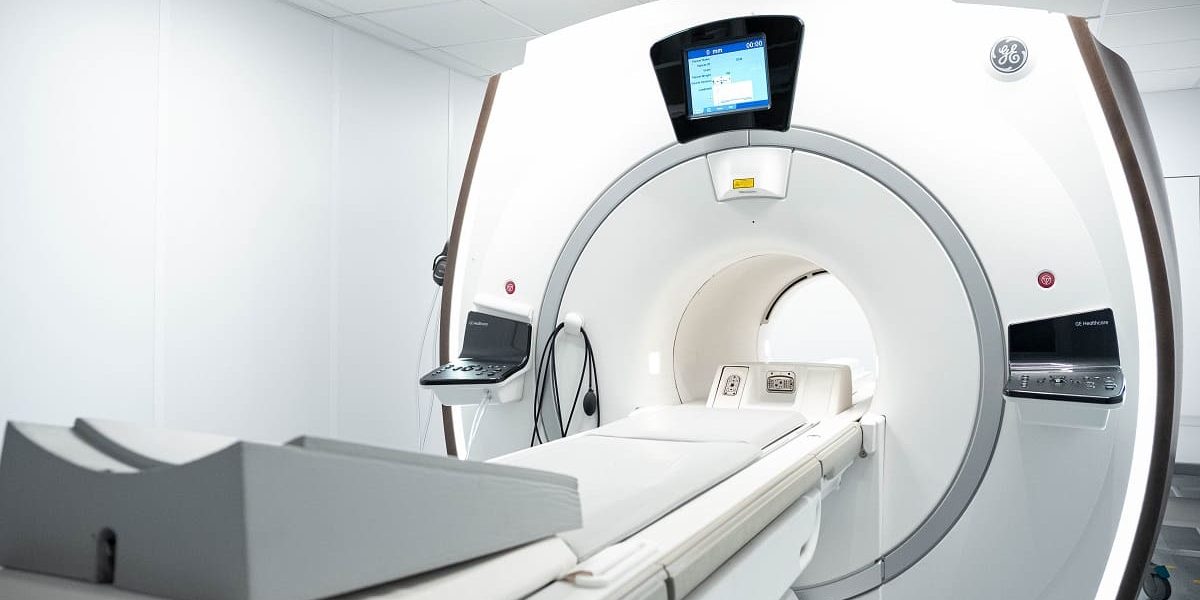
The examination is performed on a GE MR 1.5T 450W GEM system with 32 channels , which provides high precision, 3D imaging, and a shorter diagnostic time. Shoulder MRI in Lublin is available quickly, without waiting times, facilitating efficient diagnosis and treatment implementation.
When should you have a shoulder MRI?
Your doctor may refer you for an MRI of the shoulder joint if:
- chronic shoulder pain,
- limited joint mobility,
- suspected damage to tendons, ligaments or rotator cuff,
- injuries and post-traumatic changes,
- degenerative and inflammatory changes,
- post-operative check-ups.
Thanks to GEM technology and 32 receiving channels, all shoulder structures are clearly visible, supporting quick and accurate diagnosis.
What does an MRI examination of the shoulder in Lublin look like?
The examination is painless and takes an average of 20–30 minutes . The entire time in the lab, including preparation, takes approximately 40–50 minutes.
During the examination, the patient lies still on their back, with their shoulder placed in a special coil. Modern Acoustic Reduction makes the device quieter than standard MRIs, and the wide 70 cm aperture minimizes the feeling of claustrophobia. This makes MRI comfortable even for people with a fear of enclosed spaces or those who are overweight (up to 226 kg).
Preparation for shoulder MRI Lublin without contrast
Preparing for non-contrast MRI of the shoulder is simple and requires no special procedures. To ensure a smooth and comfortable examination:
✓ Bring any previous shoulder test results, such as an X-ray, ultrasound, or previous MRI.
✓ Wear comfortable clothing without metal elements such as buttons, zippers, or straps.
✓ Report to the MRI lab at Luxmed Lublin Medical Center approximately 30 minutes before your scheduled examination time, bringing your ID.
Contraindications to performing tests
Absolute contraindications to performing the test:
- weight over 226 kg
- pacemaker/pacemaker,
- neurostimulators,
- pregnancy (inform the laboratory staff) – examination without contrast is possible only after assessing the diagnostic risks and benefits after the first trimester,
- invasive surgical, aesthetic or diagnostic procedures within the last 6 weeks (you must wait at least 6 weeks after the procedure, regardless of the body part being examined),
- metal foreign bodies in the eyeball (if in doubt, an X-ray of the eye sockets is performed),
- insulin pump or other drug delivery device, neurostimulator or other biostimulants,
- hearing implant, internal hearing aid or ossicular plastic surgery cochlear implant (if it contains ferromagnetic metals).
Relative contraindications:
- the presence of ferromagnetic metals in the body,
- Orthodontic appliances and other metallic foreign bodies in the body – the possibility of performing the examination should be discussed with the laboratory! In most cases, they are not a contraindication to the examination. Metallic foreign bodies may cause local artifacts, partially hindering the assessment of adjacent structures , or (rarely) cause heating of adjacent tissues – the examination may then be interrupted. In such cases, there is no threat to the patient's life or health.
- in the case of vascular clips, an MRI examination can be performed 6 weeks after clip implantation,
- In the case of a tattoo or permanent makeup, you must wait 6 weeks after it has been done.
Contraindications to the administration of a paramagnetic contrast agent :
- severe renal failure (if eGFR < 30 – examination possible for life-saving indications),
- pregnancy (the risks and possible diagnostic benefits should be considered),
- allergy (extremely rare cases).
Attention:
- dialysis patients – there is no need to postpone the dialysis date,
- breastfeeding period – a break in breastfeeding is not necessary in the case of tests without contrast.
FAQ
How long does a shoulder MRI take?
An MRI of the shoulder joint takes an average of 20-30 minutes , depending on the scope of the examination and the number of sequences performed. In some cases, for example, when contrast or additional images are required, the procedure may take slightly longer. It's important to remember that preparation time—changing clothes, talking with the technician, and completing paperwork—must be factored into the overall time spent in the procedure room, which adds up to approximately 40-50 minutes . Thanks to the modern GE MR 1.5T 450W GEM system with 32 channels, the examination is faster and quieter than standard devices, and the wide 70 cm resonance aperture reduces the feeling of claustrophobia.
Magnetic resonance imaging of one shoulder price
The cost of a single-shoulder MRI depends on the type of examination—whether it's performed without or with contrast. For private examinations, a referral isn't required, and patients can also take advantage of a 5% discount when paying online or at the e-Kiosk at 7 Orkana Street in Lublin .
| Name of the study | Price |
|---|---|
| Magnetic resonance imaging of one shoulder joint without contrast | 632 PLN |
| Magnetic resonance imaging of one shoulder joint with contrast | 822 PLN |
What does a shoulder MRI detect?
Shoulder MRI is one of the most accurate imaging tests in orthopedic diagnostics. It allows for the assessment of all components of the shoulder: bones, cartilage, ligaments, joint capsule, tendons (especially the rotator cuff), muscles, and the subacromial space. High-quality imaging can detect:
- rotator cuff injuries, tendon tears and strains,
- damage to ligaments, joint capsule and cartilage,
- degenerative and inflammatory changes,
- post-traumatic changes after sprains, dislocations or fractures,
- cysts, tumors and condition after surgery
An MRI of the shoulder is much more accurate than an X-ray or ultrasound, providing a complete image of all the soft tissues and structures within the joint. In many cases, the MRI determines further treatment and the indication for surgery.
When is a shoulder MRI with contrast performed?
A shoulder MRI with contrast is used when a detailed assessment of disease processes is necessary. A physician may recommend contrast administration in cases such as suspected tumors and cancerous lesions, extensive inflammation, or to assess complications following surgical procedures. The contrast agent helps to more clearly visualize the boundaries of lesions, their degree of vascularization, and disease activity. This results in a clearer and more precise image. The decision to perform a contrast-enhanced MRI is always made by the physician, based on the patient's symptoms and previous imaging results, such as X-rays or ultrasound.
Does the shoulder MRI cover the entire arm?
No – an MRI of the shoulder focuses solely on one joint and its components: the bones, cartilage, ligaments, tendons, and muscles surrounding the shoulder. The examination does not encompass the entire upper limb, elbow, or wrist. If a more detailed assessment of a larger area is needed (e.g., the entire hand), the doctor may order additional MRI scans of other joints or the entire limb. In some cases, shoulder ultrasound or X-rays are complementary tests, but an MRI of the shoulder joint provides the most detailed image and allows for a complete assessment of changes.
Do I need a referral?
A referral is not required for a private shoulder MRI at CM Luxmed Lublin – simply schedule a convenient appointment, prepare for the test according to the instructions, and arrive for the test. This is a convenient solution for patients who want a quick diagnosis, without long waits or additional paperwork. For tests covered by the National Health Fund (NFZ), a referral is required – it is issued by a specialist physician in your health insurance plan.
Can I have a shoulder MRI if I have claustrophobia?
Yes – at CM Luxmed Lublin, we perform examinations using a modern MRI scanner with a wide aperture (70 cm) and a short tunnel, which significantly reduces the feeling of being confined. Furthermore, the machine operates more quietly thanks to Acoustic Reduction , and the examination time is shorter than with standard devices. This makes shoulder MRI well-tolerated even by people with claustrophobia. If the patient experiences severe anxiety, they should inform the staff.