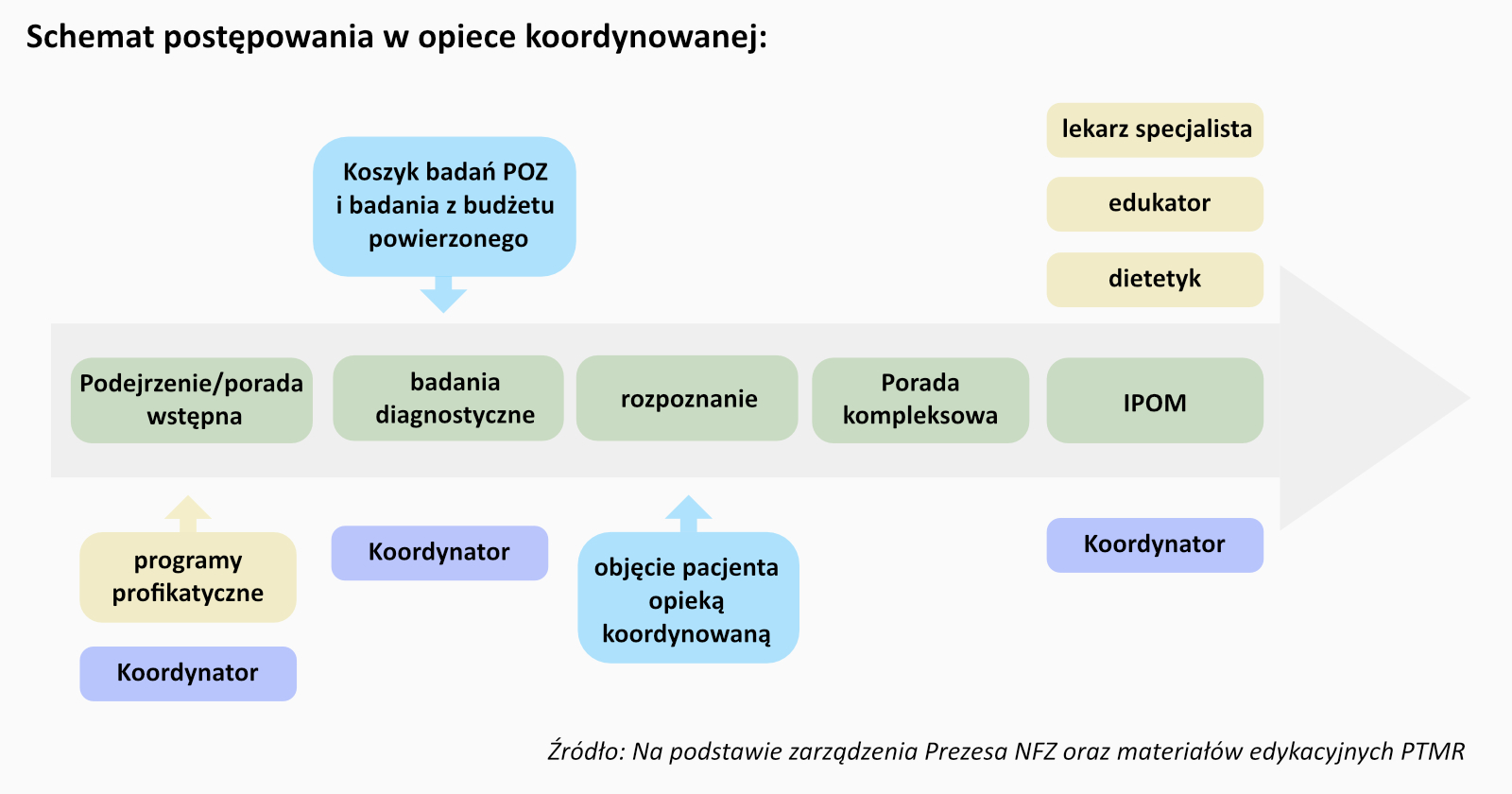

What is Coordinated Care?
Coordinated care offers comprehensive diagnosis and treatment for the most common chronic diseases within primary healthcare (PHC). Primary healthcare physicians collaborate with specialists, primary healthcare nurses, and dietitians, focusing on prevention, diagnosis, education, and treatment for patients with chronic conditions such as heart disease, endocrine disorders, diabetes, lung disease, and kidney problems.
The most important element of coordinated care is a comprehensive consultation, during which the primary care physician:
- Conducts a thorough interview with the patient.
- He examines the patient.
- Review the patient's previous test results and medical records.
- Prepares a special Individual Medical Care Plan (IPOM) for the patient, which is a schedule of examinations and consultations for the next calendar year.
What does the patient gain??
Comfort → The coordinator will arrange all tests and specialist consultations planned by the doctor
Convenience → At POZ CM Luxmed, all consultations and tests are available at our locations
Time → You no longer have to wait years to see a specialist for free. Coordinated care provides specialist consultations at a time that's convenient for you.
Awareness → Thanks to educational advice, you know what your disease is and how you can fight it.
Better care in primary care → In the coordinated care program, the patient receives a wide range of laboratory tests.
Free participation → coverage of care does not generate any costs for the patient.
How to join Coordinated Care at Primary Care Centre Luxmed?
- Submit a declaration at our POZ.
- Make an appointment with your primary care physician, who will conduct a medical interview to determine whether you qualify for the coordinated care program.
Coordinated care services provided in at least one of five paths:
- cardiological : hypertension, heart failure, ischemic heart disease, atrial fibrillation;
- diabetic ; diabetes, prediabetes,
- pulmonary/allergological : COPD, asthma,
- endocrine : hypothyroidism, single/multiple nodules, hyperthyroidism,
- nephrological: chronic renal failure.
If you are a primary care patient of CM Luxmed and have been diagnosed with one of the conditions mentioned above, you may be covered by Coordinated Care.
As part of Coordinated Care, the primary care physician may also order diagnostic tests to confirm or rule out a chronic disease.
Diagnostic tests available to primary care physicians financed from the entrusted budget
as part of the cardiology path
- Transthoracic echocardiography
- Holter ECG 24, 48 and 72 hours.
- Holter RR
- Stress ECG (stress test ECG)
- Doppler ultrasound of the carotid arteries
- Doppler ultrasound of the veins of both lower limbs
- Doppler ultrasound of the arteries of both lower limbs
- UACR (urine albumin/creatinine ratio)
- BNP (NT-pro-BNP)
- Albuminuria
as part of the diabetes path
- Doppler ultrasound of the veins of both lower limbs
- Doppler ultrasound of the arteries of both lower limbs
- UACR (urine albumin/creatinine ratio)
as part of the endocrine pathway
-
- anti-TPO
- anti-TSHR
- anti-TG
- fine-needle biopsy of the thyroid (adults only)
as part of the pulmonary path
-
- spirometry
- spirometry with diastolic test
as part of the nephrology path
-
- UACR (urine albumin/creatinine ratio)
Who is the coordinator?
The person who will ensure the proper conduct of the process will contact the patient receiving coordinated care to:
- planning of requested specialist consultations, educational and dietary advice,
- scheduling scheduled laboratory and diagnostic tests. He will also confirm and remind you about them.
- He informed about other assumptions of IPOM along with monitoring its implementation.