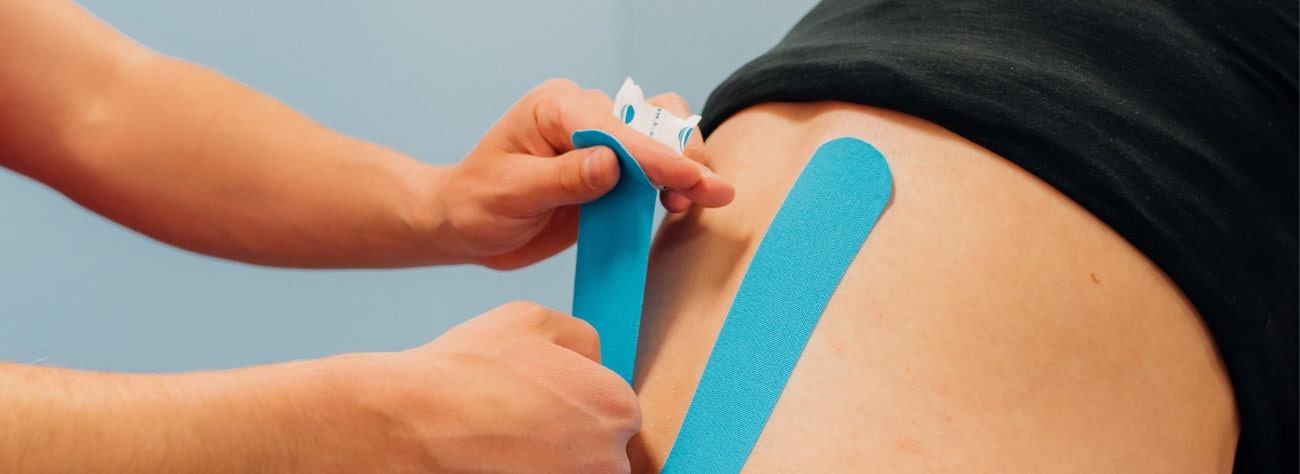
Kinesiotaping is a technique in which a special elastic tape (plaster) is applied to a specific area of the body. It is permeable to water and air, does not cause skin allergies, and can be worn continuously for several days to several weeks.
Purpose and action of the rehabilitation tape:
- Pain reduction
- Removal of lymphatic stasis and edema
- Support for muscle function (reduces, increases and normalizes tension)
- Increasing range of motion
- Reducing inflammation
Indications for use of the rehabilitation tape:
- Spinal pain syndromes
- Posture correction (postural defects, scoliosis)
- Post-traumatic conditions of muscles and joints
- Dislocations
- Sprains
Kinesiotaping is primarily used to support abdominal muscle function. Appropriate application of the tape can increase or decrease the tension in the rectus abdominis and external oblique muscles, thus supporting the function of the postural muscles responsible for proper posture. Maintaining proper posture, on the other hand, helps prevent lower back pain. The choice of technique depends on both the desired goal and the patient's experience. An additional benefit of this application is its effect on the skin, which can prevent stretching and the formation of stretch marks.
Along with abdominal muscle taping, a technique is used to support and stabilize the ligaments in the lumbar-sacral region. This optimal form of application counteracts back pain by symmetrically equalizing the tension in the muscles responsible for correct posture. Kinesiotaping is also applied to the sacroiliac joints, which improves lymphatic flow and, through stabilization, minimizes painful movements.